Triangles Are Your Friend
moving your story forward whilst creating the sensation of life fortuitously captured, perhaps


In my twenties, I played in some sloppy punk-ish rock bands when I was living in Arkansas. I’m no one’s idea of a musician, so I mostly got by on gusto, booze, and vibes. One of my bands was called Black Cassette and I was the singer/songwriter/frontman. We sounded a bit like drunken middle-schoolers covering Pavement, Velvet Underground, and Guided By Voices songs.
The other band I was in was called Dora Maar and was closer to a New Order/Joy Division/Public Image Limited post-punk sound. I played bass in this band, which had a significantly higher level of musicianship than Black Cassette. (For one, the singer could actually sing.) Since I didn’t know what I was doing musically, most of the songs were written first on bass and drums, with our guitarist and our lead singer eventually joining the process once the rhythm parts were figured out in isolation.
Our guitarist Zack would come up with crazily inventive, strange, angular guitar parts. You can hear one of his recent bands Glossololiacs here. (The album rips btw.) One time during one of our rehearsals, I asked Zack what chords he was playing because I couldn’t figure it out. He said he didn’t really know. He showed me his fingering on the frets:
“Sometimes I just find interesting shapes. Triangles are your friend.”
I always dug that formulation. And, I’ve found, the same thing has been true in screenwriting. I’ve found that whenever I start mixing and matching triangles, pretty soon I find myself with a story full of surprising textures and unexpected grace notes and a steady dramatic pulse.
SCENE TRIANGLES
Once upon a time I got to work with James Mangold. Mangold studied under my adopted storytelling guru Alexander Mackendrick (director of The Sweet Smell of Success, author of the impeccable book On-Filmmaking) and Jim has obviously put together a stellar career.
And like my post-punk guitarist pal Zack, Mangold is also a fan of triangles. When we were working together on Damnation, sometimes Jim would nudge me towards making my two-character scenes more complicated by introducing a third factor. Thus, creating a scenic triangle.
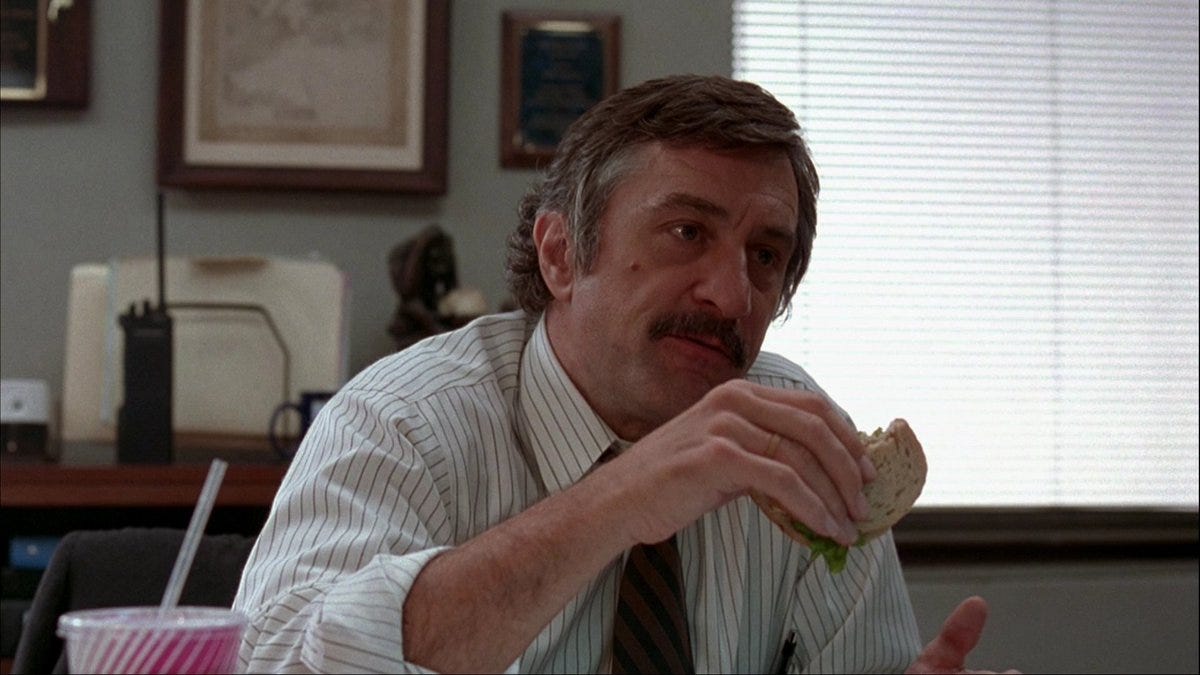
To illustrate his point, one time Jim told me an anecdote from the filming of his great film Cop Land. One of the best known scenes is when Sylvester Stallone’s small town sheriff visits the office of Robert De Niro’s internal affairs investigator. It’s the “you blew it” scene. And it’s great. But it wasn’t as special at first.
The initial scene was just a straight-up dialogue exchange about Stallone’s character (Freddy) having blown a chance introduced by De Niro’s character (Tilden) to bring down some crooked cops. From the filming script:
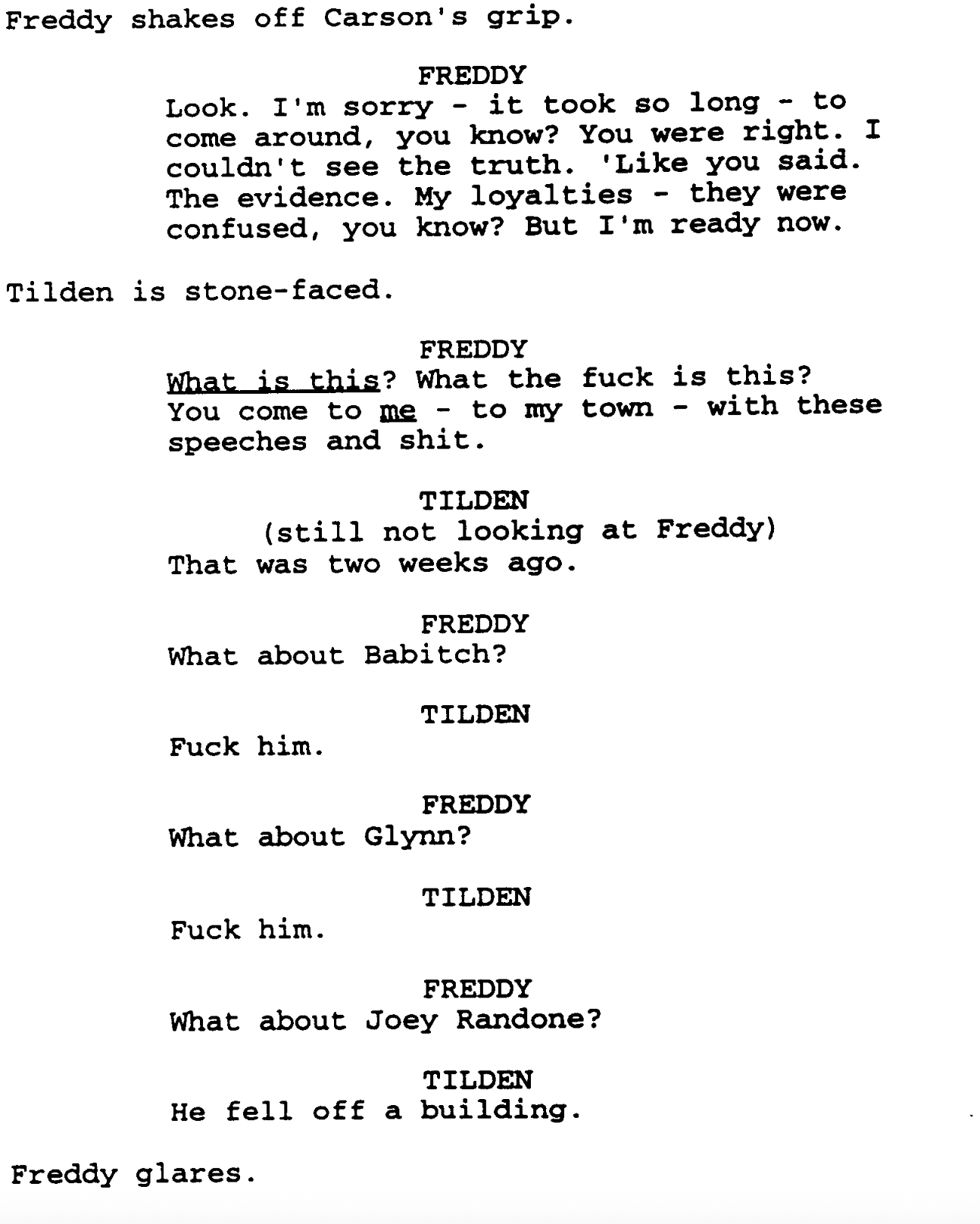
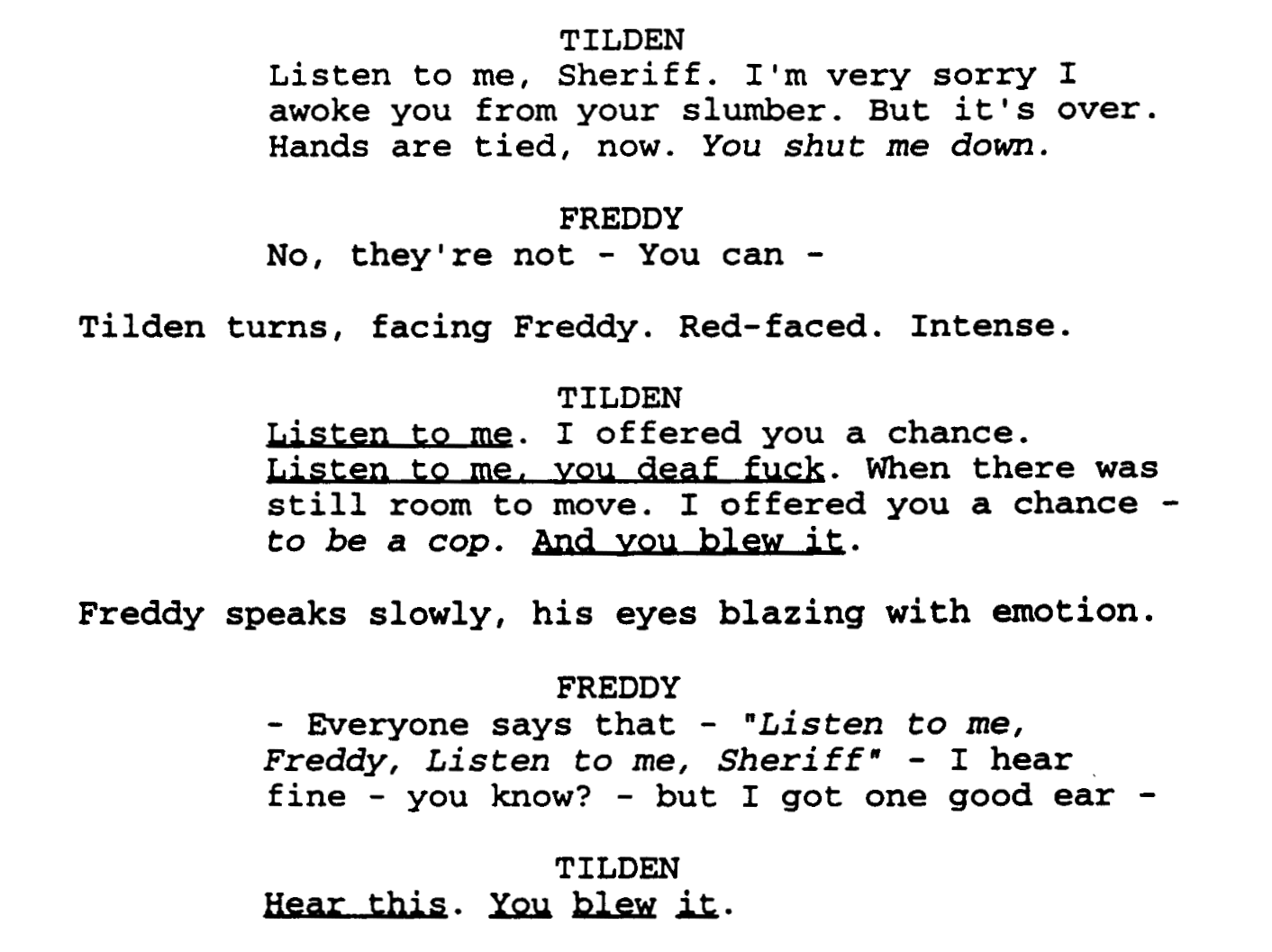
On set, this was the version they were trying to film. And it was falling flat. Jim couldn’t figure out what was missing. You had two great actors — yes, I think Stallone is a great thespian when he wants to be — performing a pivotal scene with obvious conflict. But still, it wasn’t quite special.
When filming broke for lunch, Jim tried discussing the scene with both actors. If I remember the story correctly, Stallone was very engaged but De Niro was kind of futzing around with his sandwich, not really participating. Jim kept trying to connect with De Niro but was getting nothing in return. As the lunch period was coming to an end, Jim’s frustration was mounting.
That’s when Jim had the epiphany—he needed De Niro to bring the sandwich into the scene itself. So that’s what they did when filming resumed. Here’s what it became:
It’s perhaps the most memorable scene in the film. But instead of De Niro’s face simply being stone-faced and non-responsive like in the script, his character is now not even interested enough in what Stallone is saying to listen. Instead, De Niro is fixated on his sandwich and the lack of napkins.
The introduction of this third thing — a simple sandwich — creates a whole new, and newly-layered, dynamic. Instead of reacting directly to Stallone, De Niro can now talk around his concerns and instead focus on something incredibly insignificant. This signals his lack of interest, yes, but it also crucially slows the scene down so Stallone’s frustration and the viewer’s anticipation can build.
The new additional plane of behavior and discussion that the sandwich provides is what gives the scene so much life. Back when I was a poet, one of my MFA professors (Miller Williams, rest in peace) often remarked in workshop that a good poem should spin against itself. That is, not all the moving parts should be going in the same direction. There should be friction between those moving parts. That’s where the sparks come in.
At first in the scripted version, De Niro was simply reacting to Stallone by first refusing to answer, and then by admonishing him. In the filmed sandwich version, De Niro at first doesn’t react to Stallone at all. Instead, he spins in a different direction, discussing napkins instead of legal justice. It makes the scene more tense and it makes all the characters involved feel more deeply human. It’s a fantastic scene.
I think the lesson of that Stallone/De Niro/sandwich triangle can be applied to an endless variety of stories. Say, a romantic comedy.
Let’s say a guy named Jackson realizes he’s in love with Lucille. He decides to rush to her apartment to tell her.
It’s a scene you’ve seen many times before, most likely. But it doesn’t have to have a familiar execution. In fact, I’d argue that your artistry as a writer is not in deciding to have such a scene — every genre seems to have certain types of scenes that are obligatory to them. Instead, your artistry is in how you decide how to stage the obligatory scene.
It’s one skill level to fine-tune the dialogue in what Jackson says and how Lucille responds. But it’s another skill level to create a suspenseful and/or uncomfortable triangle by introducing some third thing into the scene.
What that thing is depends on your writerly sense of tone, purpose, restraint. You could have Jackson arrive just as Lucille is concluding a successful first date with some new guy. Or you could have her hosting a “Fuck You Jackson” party. Or you could have her dog-sitting a pit bull named Randy who won’t stop trying to hump Jackson’s leg while Jackson is trying to spill his heart out to Lucille.
Or, the third thing could be another sandwich. Whatever it is, Jackson and/or Lucille should reveal something about themselves or about the conflict in how they interact with that third thing. (Similar to how De Niro revealed his attitude concerning Stallone by prioritizing the sandwich over Stallone’s pleas.)
Let’s take the leg-humping dog version of the scenic triangle. Jackson can say “I love you, Lucille” in any iteration of this scene, but the sentiment will land very differently if he kicks the dog as he says it, or if he passively lets the dog go to town as he says it, or if he tenderly diverts the dog before saying it. Whichever version you choose, I’d argue that the scene now has a sudden jolt of uncertainty and energy, and is potentially more memorable and alive than a purely one-on-one dialogue version of the scene.
One of the first things I posted on this blog back in the day was my list of Script Principles. I still stand by this key principle:

The great thing about creating a triangle in a scene is that it introduces an object (or a character) (or an event) through which the key desires and goals of the scene can indirectly come to life. Because life is rarely a therapy session where people simply articulate their desires in well-formed sentences. In life, we often deflect, misrepresent, misunderstand, or try to ignore our desires. But they come to the surface in some weird form anyway.
STORY TRIANGLES
Here, I’m simply talking about constructing relationship triangles. Love triangles are tried-and-true, of course. But especially in TV, I think it’s beneficial to create other types of triangles as well.
We did this on Longmire in a pretty classical fashion, but it always led reliably to strong drama and good scenes. Longmire is about a widowed sheriff in Wyoming named Walt Longmire. He has an at times turbulent relationship with his daughter Cady, who is an idealistic lawyer.
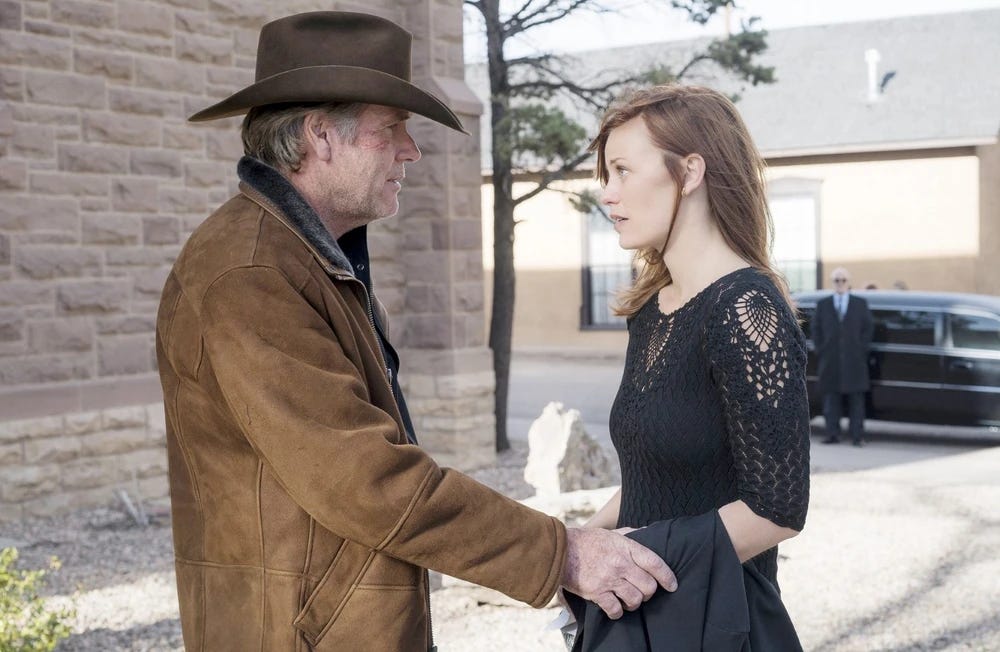
Walt also has a fairly antagonistic relationship with his ambitious young deputy Branch Connally, who comes from a very rich family and who is challenging Walt for sheriff during season one.
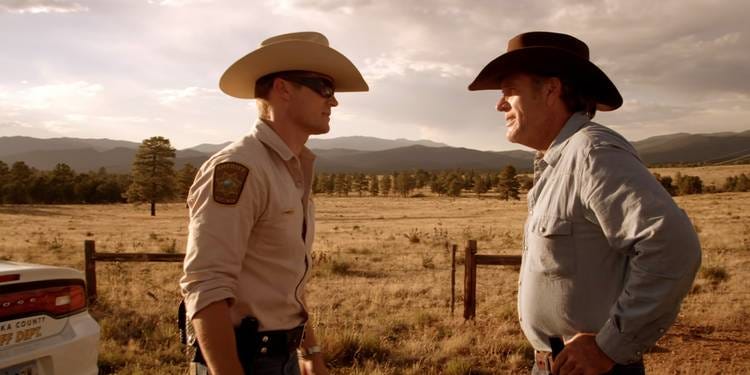
In the midst of all of this, Cady and Branch begin secretly having a romantic relationship.
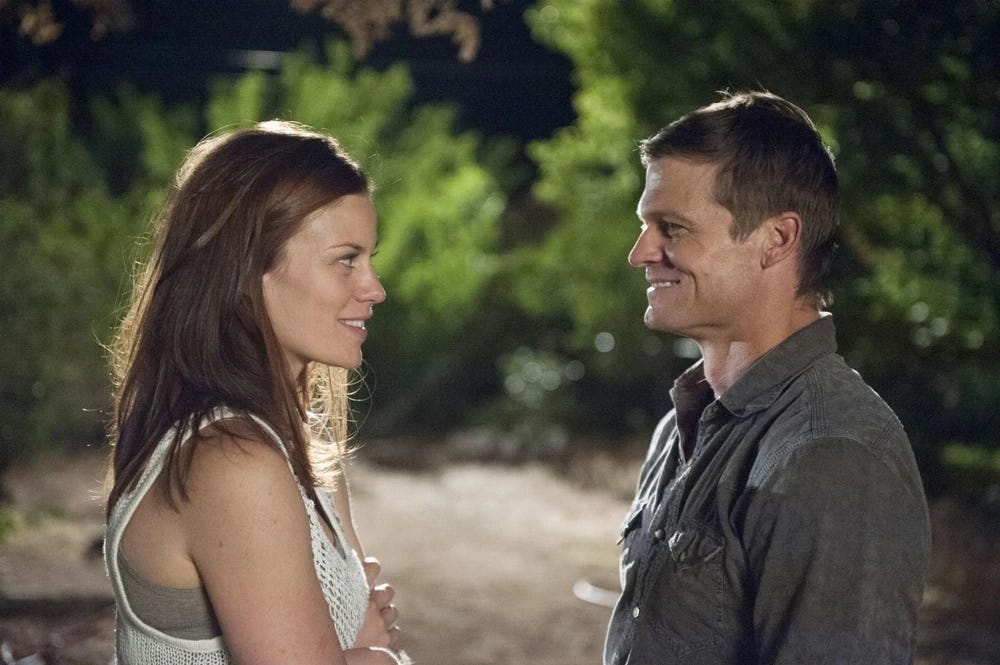
So, conceptually-speaking, it was nothing mind-blowing. But man did it work. Once these dynamics were established, any scene between any of these pairings above became dramatically loaded. Shit suddenly got fairly taut.
Now, when Walt and Branch are investigating a crime scene together, Cady is implicitly dramatically-present in the scene. This was true before Walt found about the secret relationship. Implicit dramatic questions would abound: Will Walt find out? Will Branch misinterpret a stray remark and give away the secret? Is Branch actually in this relationship as a power play?
And it was also there after Walt found out about the relationship. A dry procedural scene between Walt and Branch would suddenly turn dramatically-tense as they tip-toed around the issue.
Likewise, Branch was now dramatically-present in any scene between Walt and Cady. Will Walt express his sense of betrayal and disappointment to his daughter? Will Cady express her bitterness that her father prioritizes his professional calling over her personal happiness? And Walt was also now implicitly there in any Cady-Branch scene.
In writing dialogue scenes involving this triangle, we could toy with lines that subtly spoke to each character’s worries or desires about the evolving dynamic. How these characters communicated and heard each other — or didn’t — allowed us to subtly reveal character while pushing our story forward. Any Branch-Walt, Walt-Cady, Cady-Brance scene was now implicitly a triangle scene, simply because the specter of the missing third character could always come into play.
When you create a healthy handful of relationship triangles, you’ll usually find yourself with a nice mix of overlapping and conflicting romantic relationships, family relationships, professional relationships. You’ll develop a trove of juicy secrets and hidden histories. Your characters will often find themselves in impossible dilemmas where they can no longer have it all.
Now, they have to decide which relationships / secrets / values / allegiances they most prioritize. They have to decide what they’ll fight for and what they’ll sacrifice. It’s the heart of drama, as far as I’m concerned. If you design these triangles intelligently and tend to them ruthlessly and/or sensitively, you’ll also often find that new scenes and even new story-lines will seemingly start writing themselves. And screenwriting-wise, that’s kind of the dream.
As in all things, this lesson is also present in the great text of our time, 30 Rock.
Episode one.
The third heat.
So true. Conflict by itself can be tense, but conflict with a third element is unpredictable because the audience isn't sure which aspect will ultimately win out. Plus, viewers will tend to project subconscious intent onto that third aspect by default. In the Cop Land sandwich scene, the sandwich not only represents De Niro's disregard for Stallone, but it also serves as a unifying action between De Niro and his colleague. When they share the sandwich, it visualizes to Stallone, "we're in, you're out," with a metaphor that goes deeper than words.